
The Air Force Space Command Network Operations and Security Centre in Colorado. Photograph: Rick Wilking/Reuters
Sunday, April 22, 2012
Monday, April 16, 2012
How to sell a hot smartwatch: Add iPhone support

A Kickstarter project to bring a new smartwatch to market blew through its $100,000 funding goal in its first day, and two hours later it crossed the $200,000 mark. As a result, the Pebble E-Paper Watch should be coming to market within the next few months with an an expected retail price of more than $150.Smartwatches aren’t exactly new, but what’s unique about the Pebble is that it works with both Android devices and the iPhone.
I’ve tested a handful of smartwatches in the past year: Wearable devices that communicate with smartphones over a Bluetooth connection. These do more than just tell the time, of course. Thanks to the wireless link, smartphone data can be sent to the watch. Think calendar alerts, SMS and text messages, emails and incoming Caller ID information, for example. Some even run full apps. Until now, however, none have worked with the iPhone.

According the team behind Pebble, their solution was to join the Made for iPhone (MFi) program and license Apple’s technology for use with the smartwatch. It’s this program that manufacturers use for hardware that’s compatible with Apple’s 30-pin connector, such as docks, clock radios and cables.
New iPad overcomes last year’s supply chain woes

On its third turn doing a global iPad roll out, Apple seems to have its supply chain humming along nicely this year. The new iPad, which is already for sale in 35 countries as of today, will be showing up on shelves in 12 new countries this Friday, Apple announced Monday. And by the following Friday, it’ll arrive in nine more countries, for a total of 56 in about six weeks.
The fast roll out stands in contrast to 2011, when the iPad had hit just 39 countries in about five weeks. Besides the fact that Foxconn, Apple’s chief contract manufacturer wasstruggling to hire enough people to get iPads put together and out the door, there were also supply chain constraints for much of the global electronics industry last spring as a result of the Japan earthquake.
Though Apple’s website shows new orders still take about one to two weeks to deliver, the rollout goes on. Those new countries, by the way, are: Brunei, Croatia, Cyprus, Dominican Republic, El Salvador, Guatemala, Malaysia, Panama, St Maarten, South Korea, Uruguay, Venezuela, Colombia, Estonia, India, Israel, Latvia, Lithuania, Montenegro, South Africa and Thailand.
One of Apple’s most important markets still has yet to see the new iPad in stores: China. Several weeks ago, official certification documents surfaced indicating that the Wi-Fi-only version of Apple’s latest tablet was closer to being cleared for sale in the country.
US and China engage in cyber war games
US and China engage in cyber war games
Exclusive: US and Chinese officials take part in war games in bid to prevent military escalation from cyber attacks
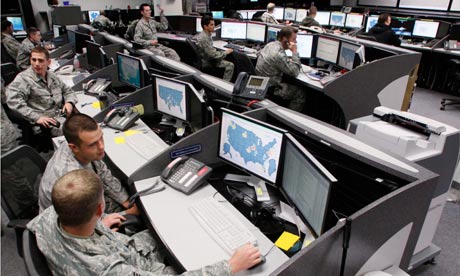
The US and China have been discreetly engaging in "war games" amid rising anger in Washington over the scale and audacity of Beijing-co-ordinated cyber attacks on western governments and big business, the Guardian has learned.
State department and Pentagon officials, along with their Chinese counterparts, were involved in two war games last year that were designed to help prevent a sudden military escalation between the sides if either felt they were being targeted. Another session is planned for May.
Though the exercises have given the US a chance to vent its frustration at what appears to be state-sponsored espionage and theft on an industrial scale, China has been belligerent.
"China has come to the conclusion that the power relationship has changed, and it has changed in a way that favours them," said Jim Lewis, a senior fellow and director at the Centre for Strategic and International Studies (CSIS) thinktank in Washington.
"The PLA [People's Liberation Army] is very hostile. They see the US as a target. They feel they have justification for their actions. They think the US is in decline."
The war games have been organised through the CSIS and a Beijing thinktank, the China Institute of Contemporary International Relations. This has allowed government officials, and those from the US intelligence agencies, to have contact in a less formal environment.
Known as "Track 1.5" diplomacy, it is the closest governments can get in conflict management without full-blown talks.
"We co-ordinate the war games with the state department and department of defence," said Lewis, who brokered the meetings, which took place in Beijing last June, and in Washington in December.
"The officials start out as observers and become participants … it is very much the same on the Chinese side. Because it is organised between two thinktanks they can speak more freely."
During the first exercise, both sides had to describe what they would do if they were attacked by a sophisticated computer virus, such as Stuxnet, which disabled centrifuges in Iran's nuclear programme. In the second, they had to describe their reaction if the attack was known to have been launched from the other side.
"The two war games have been quite amazing," said Lewis. "The first one went well, the second one not so well.
"The Chinese are very astute. They send knowledgeable people. We want to find ways to change their behaviour … [but] they can justify what they are doing. Their attitude is, they have experienced imperialism and they had a century of humiliation."
Lewis said the Chinese have a "sense that they have been treated unfairly".
"The Chinese have a deep distrust of the US. They are concerned about US military capabilities. They tend to think we have a grand strategy to preserve US hegemony and they see a direct challenge.
"The [Chinese officials] who favour co-operation are not as strong as the people who favour conflict."
The need for the meetings has been underlined in recent months as the US and the UK have tried to increase pressure on China, which they regard as chiefly responsible for the theft of billions of dollars of plans and intellectual property from defence manufacturers, government departments, and private companies at the heart of America's national infrastructure.
Analysts say this amounts to "preparation of the battlefield", and both the UK and the US have warned Beijing to expect retaliation if it continues.
In recent months, the US has made clear it is turning its military focus away from Europe towards the Pacific to protect American interests in the region.
"Of the countries actively involved in cyber espionage, China is the only one likely to be a military competitor to the US," Lewis said.
"US and Chinese forces are in close proximity and there are hostile incidents … The odds of miscalculation are high, so we are trying to get a clear understanding of each side's position."
Lewis believes the US is preparing to become more aggressive towards China, saying President Barack Obama has already tasked internal working groups in the White House to consider tougher sanctions.
Without naming China, a senior executive in the FBI told the Guardian the threats posed from cyber attacks were alarming.
"We know that the capabilities of foreign states are substantial and we know the type of information that they are targeting," said Shawn Henry, executive assistant director of the FBI's cyber unit.
"We have seen adversaries that have been in networks for many months or even years in some cases, undetected. They have essentially had free rein over those networks … They have complete ability to disrupt that network entirely."
Frank Cilluffo, who was George Bush's special assistant on homeland security, said the time had come to confront China.
"We need to talk about offensive capabilities to deter bad actors. You cannot expect companies to defend against foreign intelligence services. There are certain things we should do if someone is doing the cyber equivalent of intelligence preparation of the battlefield of our energy infrastructure.
"To me that's off grounds. That demands a response. What other incentive could there be to map our infrastructure in the event of a crisis?
"We have a stronger hand in conventional military and diplomatic means. We need to show them our cards. All instruments on the table. I think we do have to start talking active defence."
He said the US had to be proactive or, in time, people would start losing confidence in the integrity of the internet and computer systems.
"If I don't invest because I am afraid, if I don't use the web because I am afraid, if you lose trust and confidence in those systems, the bad guys have won. Checkmate."
The state department refused to speak about the war games, or say which officials took part.
A spokesman said: "The United States is committed to engaging countries to build a global environment in which all states recognise and adhere to norms of acceptable behaviour in cyberspace. We are engaging broadly with the Chinese government on cyber issues so that we can find common ground on these issues which have increasing importance in our bilateral relationship."
The Pentagon declined to comment or say which of its officials took part in the war games.
China has consistently denied being responsible for cyber attacks on the US and other western countries. It says it is also the victim of this kind of espionage.
The Chinese defence minister, Liang Guanglie, has said Beijing "stands firmly against all kinds of cyber crimes".
"It is hard to attribute the real source of attacks and we need to work together to make sure that this security problem won't be a problem," he said.
"Actually in China we also suffered quite a wide range [of], and frequent, cyber attacks. The Chinese government attaches importance also on cyber security and stands firmly against all kinds of cyber crimes. It is important for everyone to obey or follow laws and regulations in terms of cyber security."
The People's Daily, the Chinese newspaper that most reflects the views of China's ruling Communist party, said last year that linking China to internet hacking attacks was irresponsible.
"As the number of hacking attacks on prominent international businesses and organisations has grown this year, some western media have repeatedly depicted China as the villain behind the scenes."
Google fined by FCC over Street View Web giant to pay $25,000 for collecting personal information without permission and impeding investigation

Google has been fined $25,000 by the FCC over Street View
Google has been fined $25,000 for impeding a US investigation into its collection of wireless network data for its Street View project, which allows users to see street level images when they map a location.
The Federal Communications Commission imposed the fine late on Friday, saying Google had collected personal information without permission and had then deliberately not co-operated with the FCC's investigation.
The company collected the data between 2007 and 2010, when a car driving around various locations in the US and, later, Europe, took photos of locations from public places – but also collected information from unprotected Wi-Fi networks, including the location, name and in some cases the content including emails.
The FCC's investigation was left unresolved, according to the New York Times, because one key participant – the Google engineer in charge of the project – cited Fifth Amendement rights and declined to talk to it. The US constitution's Fifth Amendment protects the right to silence of someone accused by the government of a crime.
"Google refused to identify any employees or produce any emails. The company could not supply compliant declarations without identifying employees it preferred not to identify," said an FCC order dated 13 April. "Misconduct of this nature threatens to compromise the commission's ability to effectively investigate possible violations of the Communications Act and the commission's rules."
Google said at the time that the collection of data from the networks was an error and suggested it was down to an error by those in charge of the information collection. But according to the New York Times, the engineer says that others further up at Google must have known of what was happening.
The discovery of the data collection caused a storm when it was revealed in 2010. European data protection agencies reacted in different ways, with the Irish and UK commissioners suggesting Google should destroy the data without penalty, while in Germany they said they would need to examine it to determine whether any crime had been committed.
In the US, the FCC tried to make a similar determination, as did the consumer-focused Federal Trade Commission. The FTC closed its inquiry, while the FCC considered whether there had been a breach of the US Communications Act's clauses on wiretapping.
In the end it determined that it had not, because there was no precedent for applying it to Wi-Fi communications.
Google said in a statement that it had turned over information to the agency and challenged the finding that it was unco-operative. "As the FCC notes in their report, we provided all the materials the regulators felt they needed to conclude their investigation and we were not found to have violated any laws," the company said in a statement. "We disagree with the FCC's characterisation of our co-operation in their investigation and will be filing a response."
Between May 2007 and May 2010, Google collected data from Wi-Fi networks throughout the US and across the world as part of its Street View project, which gives users of Google Map and Google Earth the ability to view street-level images of structures and land adjacent to roads and highways.
But Google also collected passwords, internet usage history and other sensitive personal data that was not needed for its location database project, the FCC said.
Google publicly acknowledged in May 2010 that it had collected the so-called "payload data".
Google's window of opportunity for its Android tablet is closing fast
Google's window of opportunity for its Android tablet is closing fast
The approach of Windows 8 on tablets - now less than six months away - will put extra pressure on Google, as its own Android products struggle against Amazon's forked version and the iPad's dominance
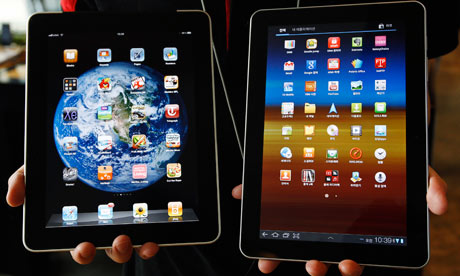
One dominates, one lags: Apple's iPad (on left) sold 40m in 2011 while Samsung's Galaxy Tab 10.1 tablet (right) sold a few million. Photograph: Jo Yong-Hak/Reuters
The window of opportunity is closing fast for Google to make its presence felt in tablets. It's about to get caught between Apple's iPad and the rapidly approaching Windows 8 - which, on tablets, may offer everything that people need if they don't want an iPad.
In which case, what's left for Google's Android? (Note the emphasis on Google here, because Amazon's Kindle Fire has shown that non-Google Android tablets can make a splash.)
We know that Google thinks tablets are important. Here's Larry Page, Google's chief executive, who at last week's earnings discussion wasasked directly by an analyst about the company's presence in the tablet market - one which is expected to grow by about 50% per year over the next few years, and double this year.
Heather Bellini - Goldman Sachs Group Inc., Research Division:
"I was wondering, Larry, if you could walk us through your view on Google's tablet strategy via Android and the relative importance of having success with these devices in terms of achieving your long-term goal?"
Larry Page:
"Heather, that's a good question. I think that we're very excited about tablets. I think there's a number of Android tablets out there and obviously, we have strong competition there as well. I think you've seen us really invest substantially also in things like Google Play, which really give you great access to entertainment, media, books and videos and so on, and as well as the apps. And we think that's an important component of what we're doing. I think there's also -- obviously, there's been a lot of success on some lower-priced tablets that run Android, maybe not the full Google version of Android. But we definitely believe that there's going to be a lot of success at the lower end of the market as well with lower-priced products that will be very significant. And it's definitely an area we think is important and we're quite focused on."
(Thanks to SeekingAlpha for the transcript.)
The rumours that Google is going to release a low-priced Google-branded tablet, made by Asus, have become pervasive; from the hints apparently dropped by Eric Schmidt (Google's ex-CEO, now chairman) a few months ago, to the murmurs from the manufacturing side, to the stories earlier this month that a planned launch in May of said tablet has been put off until July.
In truth, the chance for Android tablets - more particularly, for tablets running Google's Android - to grab a sizable share of the market is shrinking There are three reasons for this: Amazon (and other "white box" tablet makers) at the bottom end of the price spectrum; Apple at the top end; and Windows 8 alongside Apple to sweep up all the people who want a tablet for some sort of work but don't want an iPad.
Gartner's Carolina Milanesi put out a forecast for the tablet market last week in which she predicted that Apple will continue to dominate the field through to 2016, selling 169m per year by 2016 (compared to just under 40m last year), while Android tablets will ship 137m (compared to 17.3m last year) and Windows 8-based tablets only 43m (in 2011: 0)
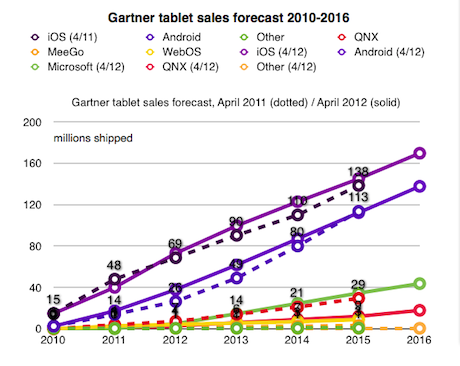
Gartner tablet sales forecast to 2016 from April 2011 (dotted line) and April 2012 (solid line)
The graph shows how her forecasts have changed since April of 2011: mostly, iPad sales were lower than expected in 2011, and of course WebOS never took off, and QNX (on the PlayBook) turned out to be an anchor instead of a balloon. At the time Microsoft hadn't said anything about Windows 8 and tablets and touch; all it had done was show that the next version of Windows would run on the ARM architecture as well as Intel's. The touch version and Metro didn't appear until the summer.
But now we know about Metro, and Windows 8. For this year, Milanesi is forecasting 73m iPads, 37.8m Android tablets (including non-Google ones), and just under 5m Windows tablets. Further ahead, she's still seeing good prospects for Android over Windows.
Now, she's the professional on this (and I respect her opinion a lot), but I beg to differ. While she doesn't distinguish between Google Android (let's call them GAndroid) and non-Google Android tablets (such as the Kindle Fire), it's clear from data given by Andy Rubin, Google's head of Android, that non-Google Android is outselling GAndroid by a substantial margin.
Subscribe to:
Posts (Atom)


