Google's window of opportunity for its Android tablet is closing fast
The approach of Windows 8 on tablets - now less than six months away - will put extra pressure on Google, as its own Android products struggle against Amazon's forked version and the iPad's dominance
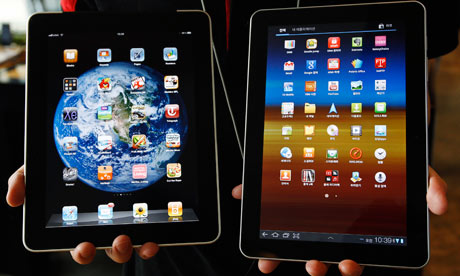
One dominates, one lags: Apple's iPad (on left) sold 40m in 2011 while Samsung's Galaxy Tab 10.1 tablet (right) sold a few million. Photograph: Jo Yong-Hak/Reuters
The window of opportunity is closing fast for Google to make its presence felt in tablets. It's about to get caught between Apple's iPad and the rapidly approaching Windows 8 - which, on tablets, may offer everything that people need if they don't want an iPad.
In which case, what's left for Google's Android? (Note the emphasis on Google here, because Amazon's Kindle Fire has shown that non-Google Android tablets can make a splash.)
We know that Google thinks tablets are important. Here's Larry Page, Google's chief executive, who at last week's earnings discussion wasasked directly by an analyst about the company's presence in the tablet market - one which is expected to grow by about 50% per year over the next few years, and double this year.
Heather Bellini - Goldman Sachs Group Inc., Research Division:
"I was wondering, Larry, if you could walk us through your view on Google's tablet strategy via Android and the relative importance of having success with these devices in terms of achieving your long-term goal?"
Larry Page:
"Heather, that's a good question. I think that we're very excited about tablets. I think there's a number of Android tablets out there and obviously, we have strong competition there as well. I think you've seen us really invest substantially also in things like Google Play, which really give you great access to entertainment, media, books and videos and so on, and as well as the apps. And we think that's an important component of what we're doing. I think there's also -- obviously, there's been a lot of success on some lower-priced tablets that run Android, maybe not the full Google version of Android. But we definitely believe that there's going to be a lot of success at the lower end of the market as well with lower-priced products that will be very significant. And it's definitely an area we think is important and we're quite focused on."
(Thanks to SeekingAlpha for the transcript.)
The rumours that Google is going to release a low-priced Google-branded tablet, made by Asus, have become pervasive; from the hints apparently dropped by Eric Schmidt (Google's ex-CEO, now chairman) a few months ago, to the murmurs from the manufacturing side, to the stories earlier this month that a planned launch in May of said tablet has been put off until July.
In truth, the chance for Android tablets - more particularly, for tablets running Google's Android - to grab a sizable share of the market is shrinking There are three reasons for this: Amazon (and other "white box" tablet makers) at the bottom end of the price spectrum; Apple at the top end; and Windows 8 alongside Apple to sweep up all the people who want a tablet for some sort of work but don't want an iPad.
Gartner's Carolina Milanesi put out a forecast for the tablet market last week in which she predicted that Apple will continue to dominate the field through to 2016, selling 169m per year by 2016 (compared to just under 40m last year), while Android tablets will ship 137m (compared to 17.3m last year) and Windows 8-based tablets only 43m (in 2011: 0)
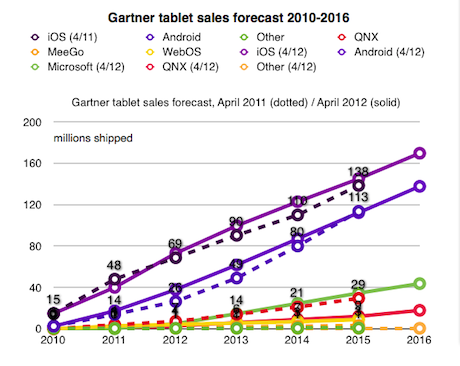
Gartner tablet sales forecast to 2016 from April 2011 (dotted line) and April 2012 (solid line)
The graph shows how her forecasts have changed since April of 2011: mostly, iPad sales were lower than expected in 2011, and of course WebOS never took off, and QNX (on the PlayBook) turned out to be an anchor instead of a balloon. At the time Microsoft hadn't said anything about Windows 8 and tablets and touch; all it had done was show that the next version of Windows would run on the ARM architecture as well as Intel's. The touch version and Metro didn't appear until the summer.
But now we know about Metro, and Windows 8. For this year, Milanesi is forecasting 73m iPads, 37.8m Android tablets (including non-Google ones), and just under 5m Windows tablets. Further ahead, she's still seeing good prospects for Android over Windows.
Now, she's the professional on this (and I respect her opinion a lot), but I beg to differ. While she doesn't distinguish between Google Android (let's call them GAndroid) and non-Google Android tablets (such as the Kindle Fire), it's clear from data given by Andy Rubin, Google's head of Android, that non-Google Android is outselling GAndroid by a substantial margin.


No comments:
Post a Comment